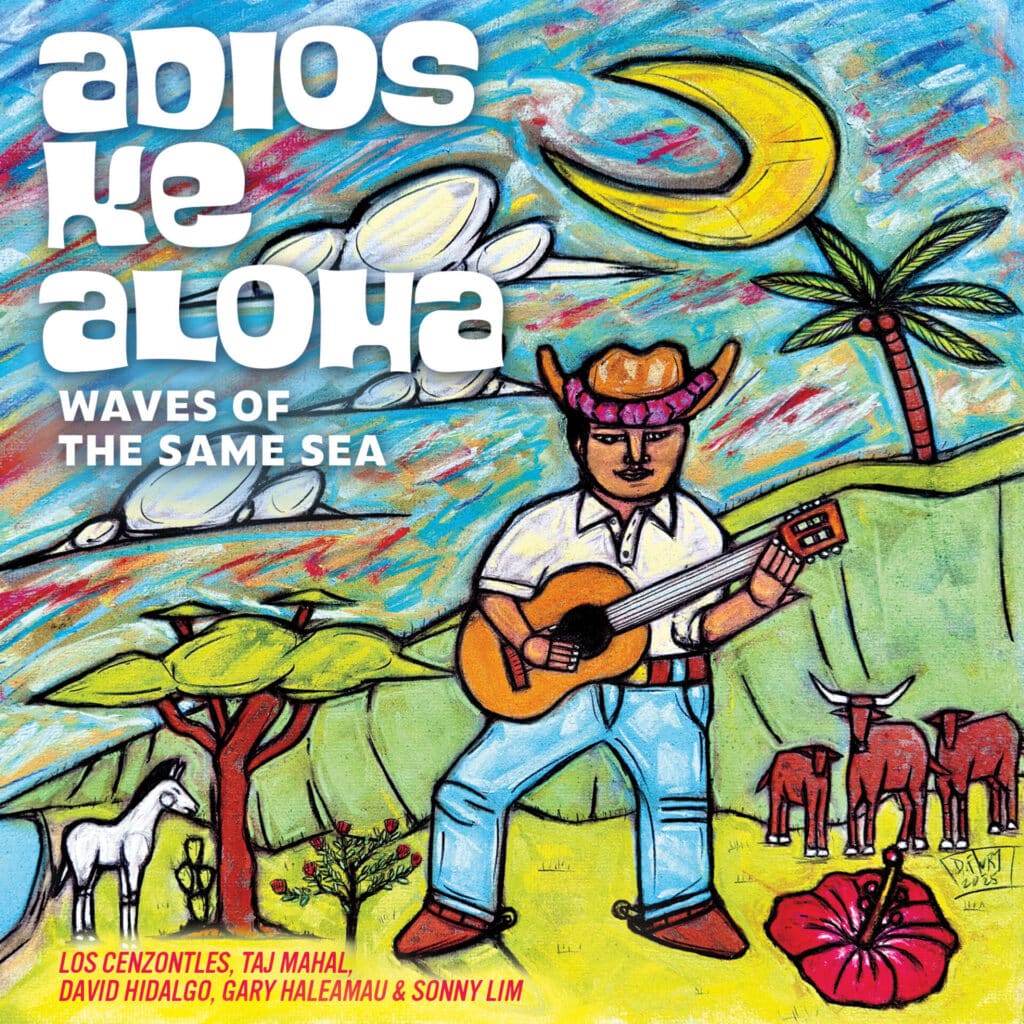
For five days in September, 2025, fourteen musicians gathered at Los Cenzontles Cultural Arts Academy, located in a strip mall storefront in a working-class neighborhood in the San Francisco East Bay. We were there to explore the musical connections between Mexico, Hawai’i, and the Afro Caribbean. Each day we would play music, enjoy home cooked meals, talk story, and sit in a circle to record music with instruments and languages from our various cultures. In the wake of the pandemic and advancements of digital technology, recording large groups of musicians live has become increasingly rare. But Adios Ke Aloha: Waves of the Same Sea, an album of deep cultural connection, required it.
Given the pivotal role that Mexicans played in the history of Hawaiian music, it is surprising that so few creative projects exploring our musical connections exist. In fact, it was Mexican vaqueros from California who introduced the guitar to Hawai’i in 1832. They were invited to teach the art of cattle wrangling to the Hawaiians who were struggling to manage the longhorn herd that was ravaging the island in the decades since it had been gifted to King Kamehameha. This visit by the Mexicans gave birth to the lifestyle of the paniolo, Hawaiian cowboys, that survives to this day.
Our musical gathering followed a year of conversations between myself and two music legends: Taj Mahal and David Hidalgo. Together we pitched songs and potential collaborators while imagining the incredible sounds we could create by blending the many varieties of Mexican and Hawaiian guitars and their varied tunings. The project would follow up our celebrated 2009 concept album American Horizon that united Mexican American and African American musical genres to tell the story of the American Journey. This time we would navigate other waters.
During the post-pandemic years, while I was considering new projects, it was David HIdalgo (known mostly for his work with East LA Chicano rockers Los Lobos) who proposed that we record another project with Taj Mahal, el ‘mero mero’ (the real deal) as he calls him. And it was Taj who proposed the idea of doing a Hawaiian project. I also consulted my longtime friend and Los Cenzontles supporter Linda Ronstadt who provided ideas and encouragement. The project became a reality when Robert Mailer Anderson—a writer, filmmaker, and ninth generation Californio with ancestors who settled in Hawai’i—provided support in the form of a residency for Taj and Dave at Los Cenzontles.
Creating cultural connections is natural for Taj Mahal, who has been forging a unique global vision steeped in his Afro Caribbean roots since the 1960s. Likewise, David Hidalgo and Los Lobos have been bringing Mexican American traditions into America’s musical heartland since the 1970s. At one moment during our recording session, Taj declared, “This is the only place this album could happen.” referring to the Los Cenzontles space, musical group, and non-profit organization, which I founded over thirty years ago. Los Cenzontles has a long history of producing projects exploring Mexico’s deep roots and our connections with various traditions that, so far, have included Irish, Louisiana Creole, Cuban, American cowboy, classical, pop, rock, and blues.
It was clear that embarking on an album that fused Mexican and Hawaiian music could not simply recycle superficial exotica, a practice so common in world music. Rather it had to be an informed and considered musical exchange that honored the depth of our traditions and connections from a place of knowledge, respect, curiosity, and love.
Both Dave and Taj have long admired Hawaiian music. For many decades, Taj has spent much of his time in Hawai’i, and in the 1990s he formed his Hula Blues Band. Dave has a special affection for the music of Hawaiian legend Gabby Pahinui whose deep traditionality and gutsy spirit continues to inspire and guide musicians within and outside Hawaiian music. As for Los Cenzontles, we first collaborated with Hawaiians in 2014 when the PA’I Foundation hosted a musical exchange with Gabby’s son Cyril Pahinui in Oahu. Even now, more than a decade later, a conversation that I had with PA’I director, kumu hula (master hula teacher) Vicky Holt Takamine about Hawaiian beliefs around personal sovereignty continues to resonate with me. In the past few years, as people of Mexican descent have become increasingly scapegoated in our own land, I often think about Native beliefs that have helped generations to cope with oppression, land theft, and humiliation, which I use to inform and bolster my own resilience. So, working on this album, and the resulting music, have provided me with a source of consolation and strength.
To create a framework for Adios Ke Aloha: Waves of the Same Sea, I sought to select songs that represented Hawaiian, Mexican, and Afro Caribbean traditions and that could accommodate the mixing of our various rhythms, instruments, and languages in an organic manner. We would write new Spanish lyrics for Hawaiian songs and Hawaiian lyrics for Mexican songs, and compose a few new tunes that would shine a light on our shared heritage. Taj would add not only his mighty vocals, but guitars, banjo and ukulele. And Dave shared his evocative voice and expressive instrumentals on a variety of acoustic and electric guitars, as well as mandolin, bajo quinto, and requinto jarocho. Both have shared the stage with some of the most renowned icons of popular culture, but they also fully respect the value of community culture bearers.
To build our team, I knew that it was critical to find skilled musicians whose connections to their root cultures were secure enough to take risks, because imagination and confidence are required to dig below stylistic boundaries. So I understood that ideally we needed musicians who actually lived their traditions.
Taj suggested that we invite two musicians who played in his Hula Blues Band: bassist Pancho Graham and lap steel player Bobby Ingano (who also has played alongside Los Lobos). I wanted to find a strong Hawaiian singer to balance the powerful voices of Dave and Taj. When I first heard a recording of Gary Haleamau singing, I forwarded it to Dave, who replied that Gary’s falsetto made him cry, and I knew then that we had found our man. On this album, Gary sings and plays ukulele and guitars, and wrote many of the Hawaiian translations of our lyrics. He also provided invaluable leadership and guidance during the recording process, generously taking the lead on creating vocal harmonies and arranging song forms. Happily, Gary’s wife Sheldeen, another kumu hula, joined us and strengthened the album’s spirit of beauty and gender balance, singing, chanting, and playing traditional Hawaiian percussion.
Sonny Lim, who sings harmonies and plays slack key guitars, ukulele, and lap steel on the album, is a name that Taj and I both recognized. A quick online search of his bio, which highlighted his deep family roots and active international touring schedule, gave me confidence that he would be a unique asset. But his bio could not convey how powerful and sensitive his music making would be, almost hidden, at first glance, by his humble, quiet nature.
Gary Haleamau and Sonny Lim have known each other since they were young teens, both having grown up on ranches on the big island of Hawai’i. Their fathers were working paniolos, and Gary and Sonny lived the life of tending farm animals as young children. They know the difficulty of labor on the ranch but also the sweetness of community music making after a long day’s work.
About his life, Sonny wrote “I was born in Kapaʻau, Hawaii. I grew up my whole childhood on Parker Ranch until I turned eleven years old. The paniolo life was unique in many ways. We had animals, pigs, chickens, and sheep, so chores were done before school and after school. We had no water heaters back then and the ranch adopted the Japanese furo (soaking tub) at all the homes, so we would have to chop wood and make a fire to heat up water everyday to take a bath. Our milk came from the ranch’s dairy. Hunting and fishing also was a common family recreation. Music was also a big thing for our family. We would watch our parents play and the neighbors would come over and it would always be a party and potluck ʻohana (family style) dinner. One of my best memories was the cattle branding (kuni pipi) that took place—watching the paniolo rope, knock down, and brand calves until we were old enough to join in. The added bonus was we got to eat the mountain oysters (laho) right off the fire burner for the branding irons!”
Of his life, Gary writes, “I was born and raised in Kalaoa, Kona, Hawaii, into a family with four generations of paniolos on both my mother’s and fatherʻs sides,” Gary was destined to live and follow in their footsteps. His father Karin Haleamau worked for HuʻeHuʻe, Pu’uwaʻawaʻa, and Keʻea ranches on Moku o Keawe for more than forty years, moving cattle from the mountain to the sea, to be shipped and sold throughout the world. “The life of a paniolo was not easy,” Gary says, “but my dad was determined to alakaʻi—lead his family while on the ranch, teaching us how to work the land and cattle and to execute daily tasks necessary to sustain our simple but intricate lifestyle. Upon returning home from a long day at work his chaps and cowboy hat were placed aside as they sang mele (songs) to reminisce and express their mahalo (thanks) to Ke Akua for keeping them safe and sound throughout the day.”
——
Once we had confirmed our visiting musicians, we then had to find a week during which everyone was available, which was a challenge because of their busy schedules. We eventually settled on a week in September and then used the months of waiting to get to know each other remotely, continue to select songs, write new lyrics for old songs, and compose a few new ones.
To find Mexican musicians for this recording, I did not have to look farther than our own community, which includes both our academy students and frequent collaborators. The city of San Pablo, California, and the adjacent Richmond, are home to generations of working-class Mexican Americans and Mexican immigrants. We are not only staffed by people from the neighborhood, we are also deeply connected to many musicians who represent the diverse regional Mexican diaspora.
For this album, I sing and play the nylon string guitar, the four-string plucked requinto jarocho of Veracruz, the vihuela and the guitarra de golpe, which are five-string strummed folk guitars played in mariachis of western Mexico. I wrote two original songs for the album, “Navegar” and “Vaquero Paniolo”, and helped to compose Spanish lyrics for some of the Hawaiian tracks alongside twenty-six-year-old Verenice Velazquez, who began in our program at the age of seven and whose family comes from a tradition of rich folk verse in the mountains of Guanajuato.
Fabiola Trujillo, who first joined Los Cenzontles in 1995 at the age of fifteen, sings with the soulful purity of classic Mexican song not often heard anymore. Until the age of seven, she lived in a small pueblo in Zacatecas, where she cultivated a deep connection to its traditions and the elders who lived them. She manages our academy and has tended to the musical education of generations of our students with great care and affection, much in the same manner as she was nurtured in her ancestral pueblo.
Silvestre Martinez is a Los Cenzontles Academy faculty member and Latin Jazz percussionist who plays drums and a variety of hand percussion instruments on Adios Ke Aloha: Waves of the Same Sea including cajon, congas, and Cuban batá. During our session conversations, we discovered that Silvestre, who grew up in a family of musicians and fishermen on the tropical Costa Chica of Oaxaca, Mexico, lived a family lifestyle that was similar in many ways to the lives that Gary and Sonny lived in Hawai’i.
Natalie Caldera (16) and sisters Belinda and Camila Ortega, (16 and 19), all of whom began as Los Cenzontles students at the age of four, play various traditional son jarocho instruments on the album, including the strummed jarana, the pandero (tambourine), the quijada (donkey Jawbone), and percussive zapateado dance. At the last moment, Natalie also stepped in to play electric bass on our two original songs with a solid groove that surprised and impressed the veteran musicians.
Harpist Leonel Mendoza, a long time collaborator with Los Cenzontles, was born in Tierra Caliente, Michoacán, but was raised mostly in California’s Central Valley within a vibrant community of arpa grande musicians, where he never gave up many of his rural Mexican customs such as hunting, skinning and harvesting large game, activities that Sonny and Gary also lived. His brilliant harp playing, which earned the admiration of all our musicians, is both delicate and hearty, forged by an active schedule of playing long gigs across California and the West for the families and communities of his home region and beyond.
Nineteen-year-old accordionist Cruz Torres of Richmond, California, grew up in a family of musicians from Oaxaca. He developed strong cultural connections to popular Mexican music playing in his family band and he now performs with a number of popular bands, including his own and with Los Cenzontles, where he also teaches accordion to neighborhood youngsters. Cruz, who plays with a depth of emotion that belies his youth, impressed the venerable elders of our recording session who mentored him as he learned new styles, chord progressions, and song forms for this album.
—-
The week of recording, during which we musicians essentially lived together, was a revelation for us all. We began the day by introducing a song to the group and then discussing which instruments we would use. Musical arrangements occurred organically with everyone’s input.
There were many magical moments. Among them, I remember the incredible feeling of hearing Sheldeen, Camila, Belinda, and Natalie fusing together Hawaiian and Mexican rhythms to create their percussive “Las Olas del Mar” using Hawaiian ipu gourd, quijada, and pandero. After Sheldeen recorded her chant “Oli ho’ohanohano” which she composed for her paniolo father in law, Verenice recited a poem that she had composed for her heritage, recited by Fabiola on “Las Olas”. The emotional synergy of both provoked spontaneous tears of deep joy and nostalgia throughout the room, as if our ancestors were present with us. When the bridge of our traditional tololoche bass, known for its percussive slap, broke, the Hawaiians sprang into action to fix it but lacked a woodshop to craft a new one. Luckily, one of our student’s fathers created a replacement at his home and lent us the necessary hand tools which the musicians used to resuscitate the instrument that we used to great effect throughout the session.
While Sonny explored the numerous and varied Mexican folk guitars at Los Cenzontles, he marveled at the similarities of their tunings with those used in Hawaiian slack key guitars. Popular myth has long insisted that the variable tunings of the Hawaiian slack key was the result of the Mexicans vaqueros not teaching the Hawaiians how to tune their guitars, forcing them to invent tunings on their own. However, the real story is that Mexican guitars had multiple tunings in the 1800’s, and still do among their many regional variations. In my mind, this truth reminds us that our ancestral heritage was born not of ignorance and neglect, but of knowledge and sharing.
Our musicians also shared knowledge and support for each other with generosity and love. Taj’s deep wisdom and sense of groove grounded us. Gary’s clarity and positive spirit lifted us. Sonny’s lap steel and slack key playing enriched us, and the songs, with the aloha spirit. And Dave never failed to surprise us with the way in which he infused the spirit of the moment into the recording.
None of the musicians of this remarkable session were driven by ego. Rather we were dedicated to the collective and to the responsibility of being tradition bearers in a modern world. The Los Cenzontles team has years of experience cultivating a welcoming environment for our guests so that creativity can flow without barriers. Instead of offering the usual granola bars and take-out food provided at most recording studios, Los Cenzontles served homemade meals daily. And on the Sunday that we served menudo (Mexican tripe soup), which I assumed many would politely decline, everyone joined in, further underscoring that this was a project of people who were firmly rooted in working-class culture and gratitude.
We recorded sixteen songs in five days. When we said goodbye, everyone felt fulfilled and buoyed by the experience, confident that something very special had just occurred. I then began to edit the files and engage a few more friends to record overdubs that completed the sound we were seeking. These included Max Baca who recorded bajo sexto from his home in San Antonio; Bobby Ingano, who could not join us live, recording lap steel in Honolulu; and Pablo Aslan, Argentine master of tango, recording stand up bass from his home in New York.
Recording a group of musicians in close proximity in a storefront studio with cinderblock walls is hardly ideal for capturing audio. But to capture the improvisatory spirit that we sought, we needed to maintain eye contact and stay close. So the work of Alberto Hernandez, who engineered the five-day session, and Greg Morgenstein, who mixed the tracks, deserve special recognition for bringing Adios Ke Aloha: Waves of the Same Sea, our musical gift, to you, the listener, with clarity and fidelity. And notably, filmmakers Chris Brown and James Hall captured the inner workings of the recording sessions with candor and careful attention to the details of the creative process. We look forward to inviting you all into the healing magic of our gathering through this recording and film.
Culture is a fabric within which we are all woven.
Eugene Rodriguez
Los Cenzontles